
A headline lands in your inbox. NERSA. New trading rules for electricity. Someone forwards it with one line: does this stop our solar project?
Now the question is sitting in a board pack. Nobody in the room can answer it.
So the project waits.
You can settle this yourself. It takes three questions and about five minutes.
First, three things the NERSA trading rules are not about.
Not the size of your system. Not whether you have batteries. Not whether you push power back into the grid.
Most people guess one of those. All three are wrong.
What the NERSA trading rules cover
They are about selling. That is it.
A trader buys power so it can sell it on. It moves that power over wires it does not own.
The rules govern who may stand between a maker of power and a buyer.
Your rooftop array does none of that.
You did not buy the power. You made it. You did not sell it. You used it.
You grew the vegetables and you ate them. That is not a market stall.
Making power for your own use was never trading. It still isn’t.
Rules get redrafted. That line does not move.
A note on status. When this was written, the trading rules were out in draft for public comment. They were not law yet, and draft rules change before they are signed off. Check the current wording before you rely on any of this. Nothing here is legal advice.
Three questions decide whether the rules touch you
Almost every business solar setup sits in one of three buckets.
One: does the power leave your site?
You make it on your roof. You use it in the same building. Same connection, same name on the account.
Nothing crossed a boundary. You are self-generating, and the trading question never arises.
Most business rooftops stop here.
Two: does it cross wires you don’t own?
This is wheeling. You make power at site A and move it to site B over somebody else’s network.
Now it depends on the contract. Moving your own power between your own sites is one thing. Selling into someone else’s meter is another.
Get advice before you commit.
Three: does anyone pay you for it?
A tenant. A neighbour. Someone signing a power purchase agreement, which is a long-term deal to buy your output.
That is a third-party sale. This is where the rules bite.
If you answered yes to question three, this post is not your answer. Start with a lawyer, not an engineer.
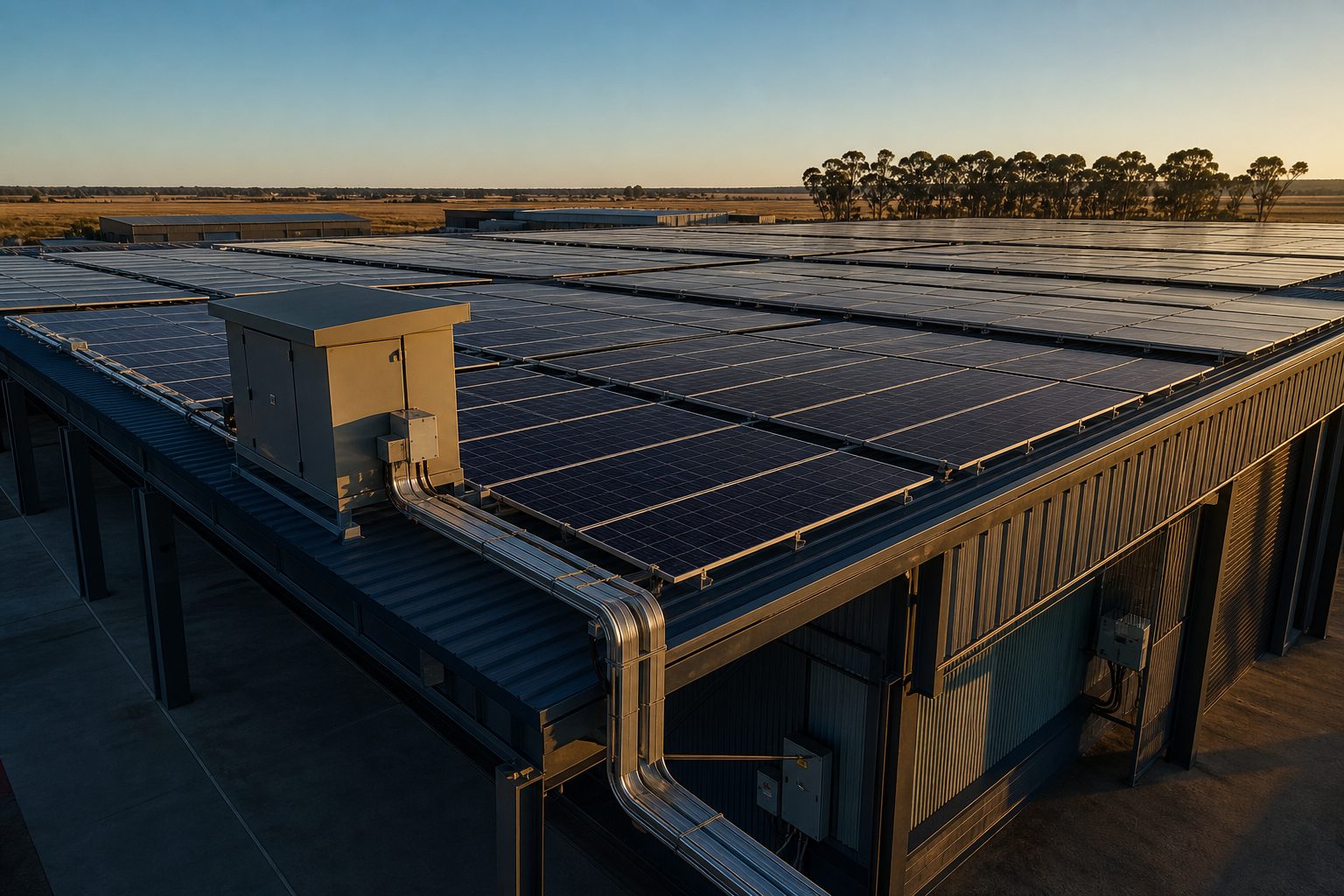
A 500 kW array on a Durban warehouse, sized to the building’s own daytime load, is self-supply.
Run a cable to the tenant next door and invoice them at month-end, and it is a different question.
A landlord recovering solar through the rent often thinks it is invisible. It isn’t.
The 1 MVA line has not moved
There is an older line in the rules, and it sits at 1 MVA.
Below it, small on-site generators are registered and the process is fairly light. Above it, you need a full generation licence and the reporting it brings.
The trading rules do not move that line.
If one site is heading toward 1 MVA, know it early. The path above the line is much heavier. Put it in the programme, not in a panicked email before switch-on.
If several sites together approach 1 MVA, ask how capacity gets counted. Per connection, per company, or added up? It is cheap to ask now and costly to argue later.
On multi-site rollouts each site stays a separate connection, with its own Eskom account and its own notified maximum demand. That is the most power Eskom agrees to supply you.
What changes on your site
Strip out the noise and three dull things affect your project.
A connection agreement. Your network owner is whoever owns the wires at your gate: Eskom, or your municipality. Any grid-tied system of size needs a signed deal with them, covering the connection, the export condition and the technical rules.
This is the most common cause of delay on the jobs I run. Start the paperwork before you order kit. Panels waiting in a warehouse are expensive panels.
Grid-code sign-off. Your inverters must meet NRS 097-2-3, the rulebook for how a small generator has to behave on the grid. Good tier-one inverters already meet it, and the maker will issue the certificate.
Cheap kit is where this goes wrong, and a failed sign-off costs months.
A meter your network can read. Any system that touches the grid needs a two-way meter. It counts power both ways and logs readings through the day.
It is a real line item. Have your installer price it up front.
Do batteries change the answer?
Not in structure, no. A battery that charges from your solar and feeds your own load is the same story with a delay bolted on.
The real question is charging from the grid. You buy cheap power at night and use it in the evening peak. Is that trading?
On a plain reading, no. You bought power and you used it yourself. Resale is the defining act, and there is no resale.
It is filling the tank when petrol is cheap. Shifting when you buy is not selling.
Do check where this lands in the final text, though. It helps to know what is at stake.
Take Megaflex, an Eskom-direct tariff that prices power by time of day.
Winter peak energy is 720.19 c/kWh. Off-peak is 120.03 c/kWh.
The gap is 600.16 c/kWh before VAT. Call it R6.00 for every unit you move out of the peak block.
That sum is why the question gets asked at all. Our guide to battery storage and peak shaving shows how the gap turns into a smaller bill.
What waiting costs you
Here is the part left out of every rules update. Waiting is not free.
NERSA got Eskom’s regulatory asset base wrong by R54.7 billion. That base is the value of Eskom’s assets that tariffs are built on.
A High Court order then forced proper public consultation. The regulator chose to claw the error back through tariffs over three years.
R12 billion in 2026/27. R23 billion in 2027/28. R19.7 billion in the period after that.
That is why Eskom-direct customers took 8.76% from 1 April 2026. Municipalities paid 9.01% more for bulk power from 1 July, and eThekwini’s end-user rise landed at 9%.
Check which one you are. If Eskom bills you, your rise came in April. If a municipality bills you, it came in July.
Without the clawback, those two rises would have been 5.36% and 6.19%.
A worked example. The assumptions, stated plainly:
- An Eskom-direct business customer.
- A bill of R100,000 a month, just before 1 April 2026.
- Usage flat year on year.
- VAT excluded.
- No other tariff or load changes.
The sums:
- At 8.76%, that R100,000 becomes R108,760 a month. That is R8,760 more, or R105,120 over twelve months.
- Without the NERSA error, at 5.36%, it would be R105,360 a month.
- The gap is R3,400 a month. R40,800 a year. For one customer.
Swap in your own bill. The sums scale.
R40,800 a year, on one account. Not because you used more power. Because of a sum somebody else got wrong.
Now look ahead. This year’s slice is R12 billion. Next year’s is R23 billion.
So the rise in the bill on your desk is the small one.
You are reading this in Eskom’s high-demand season, June to August. Winter rates. Not the gentle version.
Anyone pricing a solar payback off today’s tariff is being careful, not hopeful. Our Eskom tariff and load shedding outlook sets out where this goes next.
Every month you wait for a draft is a month at full rate.
Four things that keep this off your desk
All four cost nothing. Together they take the rules question out of a behind-the-meter system.
1. Size to your load, not your roof. Run a twelve-month load profile first. If your daytime minimum load is 300 kW, a 280 kW array offsets what you already use. A 450 kW array builds you an export problem. Our note on choosing the right system size covers the method.
2. Set the inverters to zero export. Every modern inverter can cap export. If you use all you make, you lose nothing by setting it. You gain proof that no power left your property.
3. Keep the paperwork boring. One legal entity. One connection. One meter. One signed agreement. Any setup that needs a clever story will one day need one for somebody senior.
4. Talk to your network owner before you order. The clock only starts once your submission is complete, and an incomplete one restarts it.
Do those four and the trading rules do not reach you, draft or final. That is not a loophole. It is what self-supply is.
Frequently asked questions
Do I need a trading licence for rooftop solar?
If you make the power on your own site and use it behind your own meter, you are not trading. The rules are aimed elsewhere. Registration and connection rules still apply, so do not skip those.
Can I sell solar power to my tenants?
That is a third-party sale, and it is exactly what the trading rules exist to answer. Get legal advice on the structure before you build, not after. The engineering is the easy part here. The contract decides whether it works.
Should I wait for the final rules before installing solar?
For a behind-the-meter system, waiting buys little and costs real money. Eskom-direct tariffs rose 8.76% on 1 April 2026. The clawback behind much of that roughly doubles next year, from R12 billion in 2026/27 to R23 billion in 2027/28.
What standard do my inverters need to meet?
NRS 097-2-3 is the grid connection standard for the class of on-site generation most business rooftops fall into. Good tier-one makers supply the paperwork as a matter of course. Ask for the certificate before you buy.
Get a straight answer on your own site
Is a solar decision on hold because of the trading rules? Send us the layout. In most cases a phone call is enough to tell you whether the question applies at all.
We handle connection forms, network engagement and grid-code paper as standard. Want to check the numbers first? Start with our savings calculator.
Book a feasibility conversation →
Or reach me directly: allen@terawatt.co.za · 071 940 8981
Sources. Eskom Schedule of Standard Prices 2026/27 and Eskom’s FY2027 notice. Engineering News, 10 March 2026, on NERSA’s R54.7 billion error. HBG Schindlers on eThekwini’s 2026/27 tariffs. Rates exclude VAT.
