
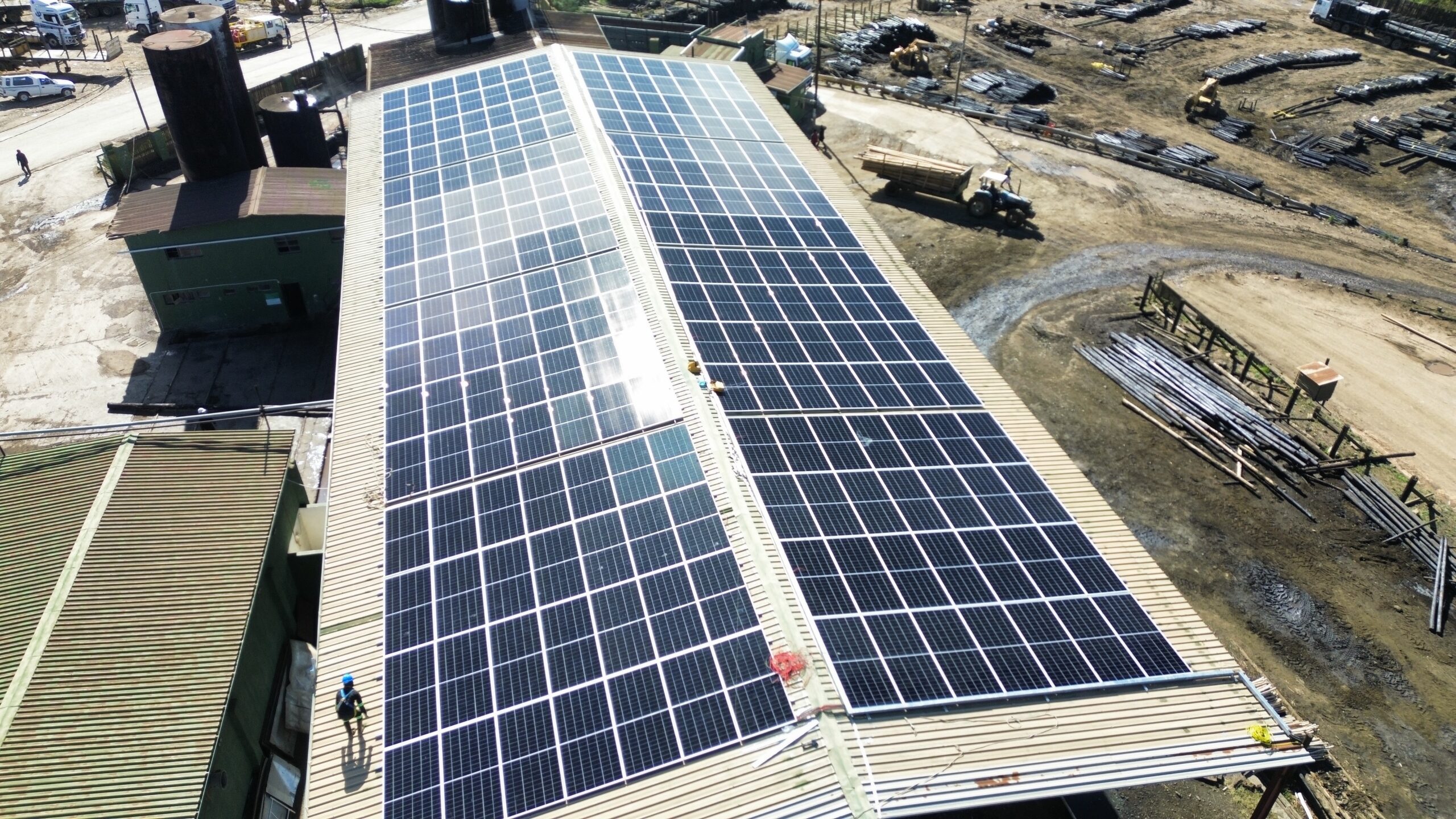

If you’re a South African business owner paying R20,000 or more per month for electricity, there’s a very good chance that between 30% and 50% of your bill comes from just 6 hours of the day. Those 6 hours — Eskom’s peak tariff periods — are costing you a fortune.
This guide breaks down exactly how peak tariffs work, what you can do about them, and how battery energy storage systems (BESS), hybrid inverters, power factor correction, and intelligent load management can transform your electricity spend from an uncontrollable overhead into a strategic advantage.
1. The Peak Tariff Problem: Why You’re Paying Up to 6x More

Eskom’s time-of-use (TOU) tariff structures — Megaflex for large consumers, Miniflex for smaller commercial users — aren’t flat rates. They’re designed to discourage electricity usage during periods of highest demand on the national grid.
Here’s how Eskom’s TOU schedule works:
- Peak periods: 07:00–10:00 and 18:00–20:00 (weekdays)
- Standard periods: 06:00–07:00, 10:00–18:00, and 20:00–22:00 (weekdays)
- Off-peak periods: 22:00–06:00 (weekdays), all weekend, and public holidays
The price difference between peak and off-peak can be 4 to 6 times. In winter, peak rates can exceed R8.50/kWh while off-peak sits around R1.68/kWh — a 5 x difference.
What this means in practice: A business consuming 50,000kWh during peak hours in winter might pay R8.50/kWh , will pay R425,000. The same 50,000kWh at off-peak costs R84,000. That’s R341,000 wasted.
Seasonal pricing is Eskom’s winter tariffs (June–August) which are significantly higher across all periods. Peak rates in winter can be double the summer peak rate.
2. The Battery Solution: Peak Shifting Explained

Peak shifting is elegantly simple: charge your batteries when electricity is cheap (off-peak), and discharge them when electricity is expensive (peak).
A battery system charges overnight at off-peak rates (as low as R0.70/kWh) and powers your business during peak periods when you’d otherwise pay R3.50–R4.00/kWh. Every kWh shifted saves R2.80–R3.30. A 200kWh battery cycling twice daily can save R36,000–R45,000 per month in off season, and R80,000 to R100,000 per month in peak seasons.
Sizing requires two key numbers:
- Peak demand (kW): How much power do you draw during peak hours?
- Peak energy (kWh): How much total energy during peak periods?
For most commercial operations, peak periods total 5 hours per day. If your average peak demand is 100kW, you need roughly 300kWh of battery capacity, cycled 2 times per day, (allowing 85% discharge) to fully eliminate peak consumption.
Solar + battery outperforms battery-only. Batteries charge from free solar energy during the day, then discharge during the evening peak — reducing payback from 5–7 years to 3–4 years.
3. Types of Battery Energy Storage Systems

Lithium Iron Phosphate (LFP)
The dominant chemistry for commercial storage. Excellent cycle life (4,000–8,000 cycles), inherent thermal stability, and strong performance in SA temperatures. Cost per kWh has dropped recently. These batteries chemistry are well understood high performing, affordable, long lasting and the only real choice in the market.
How Hybrid Inverters Work

If batteries are the muscle of your energy system, the hybrid inverter is the brain.
Three types of inverters:
- Grid-tied: Solar to grid only. No battery. No backup.
- Off-grid: Standalone with batteries. Cannot interact with the grid.
- Hybrid: Manages solar, batteries, grid, and generator simultaneously.
A modern hybrid inverter uses priority logic: solar first, excess to battery, battery during peak, grid as backup, generator if needed. This happens automatically, in milliseconds.
Key specs to evaluate: Continuous output (kW), MPPT inputs, battery voltage range, and grid interaction capabilities (zero-export compliance).
Popular platforms in SA: Victron Energy (flexible, modular), SolarEdge (strong residential-to-commercial), Solis and Deye (cost-effective three-phase), and Huawei (strong commercial offering).
5. Containerised Battery Systems: The Industrial Option

For businesses with storage needs above 200kWh, containerised BESS offers a compelling solution. A standard 20ft or 40ft ISO container arrives pre-fitted with battery modules, inverters, cooling, fire suppression, BMS, and switchgear — plug-and-play at industrial scale.
When to consider containerised BESS:
- Storage requirements exceed 200kWh
- Limited indoor space for battery racks
- Multiple sites needing standardised deployments
- Phased expansion plans
- Harsh environmental conditions
Key advantages: Speed of deployment (days not weeks), modularity (add containers as needed), weatherproofing, integrated fire safety, and remote monitoring. A typical 40ft unit houses 500kWh–2MWh.
6. Power Factor Correction: The Hidden Saving

Power factor is the ratio between useful power (kW) and total power drawn (kVA). A power factor of 0.7 means 30% of the power you’re paying for does no productive work.
Most commercial tariffs include kVA demand charges. Eskom penalises power factors below 0.96 with reactive energy charges.
The fix: PFC capacitor banks provide reactive power locally. Improving power factor from 0.75 to 0.98 reduces demand charges by 23%. ROI is typically 6–18 months.
Combined with battery storage, PFC and peak shifting together can reduce maximum demand charges by 40–60%.
7. Load Management Strategies Beyond Storage

Load Scheduling: Shift high-draw equipment outside peak hours. No capital required.
Demand Limiting: Prevent multiple large loads from starting simultaneously. One spike sets your demand charge for the entire month.
Smart Metering: Install interval metering before investing. You can’t manage what you can’t measure.
Variable Speed Drives: Adjust motor speed to match load — 20–50% energy savings on variable-load applications.
Energy Management Systems: Integrates solar, battery, tariff schedules, load priorities into a single automated control system.
8. Global Best Practices

Australia leads C&I solar-plus-storage with 3–5 year paybacks. Key learning: solar + battery always outperforms either alone.
The US pioneered demand charge management — batteries deployed to flatten peak demand spikes.
The UK developed virtual power plants and aggregators — businesses earn revenue from grid services on top of tariff savings.
South Africa ticks all three boxes for mass adoption: unfavourable tariffs, declining battery costs, and policy frameworks rewarding flexible demand.
9. How to Assess Your Opportunity
- Get your load profile — 12 months of interval data from your utility
- Identify peak exposure — if more than 25% falls in peak periods, there’s a strong case
- Size your storage — kWh for peak coverage, kW for peak demand
- Assess solar potential — even 30–50% coverage significantly improves the business case
- Calculate payback — demand transparent financial modelling from your EPC
Questions for your EPC contractor:
- What battery chemistry and why?
- Warranted cycle life and degradation profile?
- EMS or smart controller included?
- Post-installation monitoring and maintenance?
- Can the system expand in future?
- SANS 10142 compliant with valid COC?
Stop Paying the Peak Premium
Tariffs will continue to rise. The businesses that thrive will treat energy as a strategic asset, not a passive expense. Battery storage, peak shifting, hybrid solar, power factor correction, and intelligent load management are delivering measurable ROI for South African businesses right now.
The question isn’t whether to act. It’s how quickly you can stop paying Eskom’s peak premium.
Ready to Assess Your Savings?
Terawatt Energy specialises in commercial and industrial solar and battery storage systems. We provide transparent, engineering-led proposals with detailed financial modelling.
Contact us for a free energy assessment →
Terawatt Energy — Engineering Excellence in Solar EPC
