
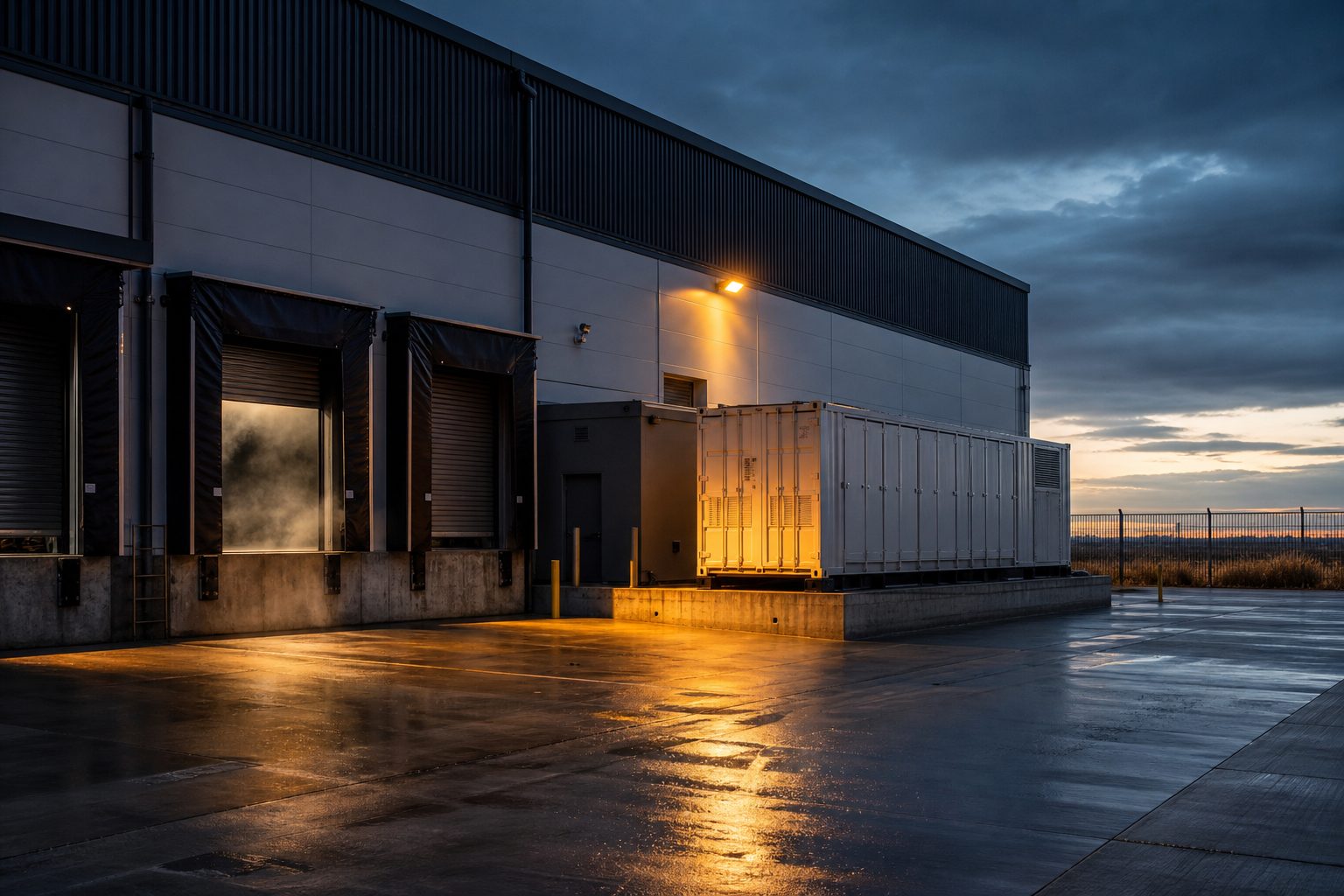
Three suppliers have quoted your cold store. All three came back with about a megawatt hour of battery. None of them walked into the freezer.
They should have. Cold storage peak shaving nearly always starts with a battery quote. It should start on your racks.
Your cold store is already a battery. You just haven’t been using it as one.
The short version
- Chill the product below setpoint before your peak. It coasts. The compressors stay off. No storage asset required.
- On Eskom’s Nightsave Urban (Large), one shaved kVA is worth R359.20 a month in winter, R104.17 in summer, excl VAT.
- Do the thermal work first and the battery drops from about 1,247 kWh to 749 kWh.
- Cold-chain compliance comes first, always. For validated chilled and pharmaceutical stock, the answer is no.
First, what it isn’t. Not a bigger battery. Not new compressors. Not solar — your peak is set by the morning recovery after defrost.
Why your cold room is already an energy store
Refrigeration is different. You can’t make Tuesday’s compressed air on Monday night. Most loads can’t be banked.
You can make Tuesday’s cold on Monday night. And you store it in the product.
Think of the ice bricks in a cooler box. Freeze them hard the night before and the box coasts all day. Your racks are the same trick at 2,000 tonnes.
Heat leaks in through the walls, the doors, the fans and the forklift traffic. Normally the evaporators soak it up — compressors running. If the product is already colder than it needs to be, the heat goes into the product. The plant idles.
You haven’t saved a unit of electricity. You’ve moved it out of the window where it costs the most. That’s what a battery does. Here the store is stock you own.
One catch. Thermal mass is slow.
Over two hours, only the outer cases on a pallet swap real heat. The core doesn’t take part. Any sum built on your full tonnage is wrong. Size on the part that moves, and prove it with probes.
What one kVA of demand is actually worth
Get the tariff right before the engineering.
Your bill has two halves. One is the electricity you used. The other is a demand charge — a fee for how wide your pipe had to be at its worst moment.
Cold stores this size on an Eskom-direct supply usually sit on Nightsave Urban (Large). Its energy rate is flat, not time-of-use — no cheap hours to chase.
So the whole game is the demand charge. Two lines fall when you shave a kVA:
- Winter (Jun–Aug): R332.91 + R26.29 = R359.20/kVA/month
- Summer (Sep–May): R77.88 + R26.29 = R104.17/kVA/month
- Per 100 kVA: R35,920 a month in winter, R10,417 in summer
- Over a full year: (3 × R35,920) + (9 × R10,417) = R201,513 per 100 kVA
R35,920 a month is a delivery vehicle payment. For power you never used.
And it’s a monthly maximum. One half-hour where the plant runs away from you sets the charge for all thirty days.
So it has to work every weekday, not on average. That’s a job for a controller. Our guide to peak shaving covers sites without refrigeration.
If eThekwini, Johannesburg or Cape Town supplies you, this isn’t your tariff. You’re on that municipality’s own schedule, and your increase landed 1 July, not 1 April. eThekwini’s was 9%. Same physics, different rate.
How much load can you actually shift?
Here’s the sum we run on site. Every input is listed, so you can swap in your own. These are Terawatt modelling inputs, not published figures.
- 4,500 m² frozen distribution centre, Eskom-direct, Nightsave Urban (Large)
- 2,000 tonnes on racks. Setpoint −20 °C, permitted floor −22 °C
- Participating mass over a two-hour window: 600 tonnes — the outer cases that actually move
- Specific heat of frozen product 1.9 kJ/kg·K. Pre-cool depth 1.5 K. Plant COP 2.0. Power factor 0.95
- Uncontrolled maximum demand 1,150 kVA, set by the morning recovery after defrost
COP is the plant’s exchange rate. A COP of 2.0 means one unit of electricity buys two of cooling.
The cooling you bank in the pre-cool:
600,000 kg × 1.9 kJ/kg·K × 1.5 K = 1,710,000 kJ
1,710,000 kJ ÷ 3,600 = 475 kWh of stored cooling
475 kWh ÷ COP 2.0 = 237.5 kWh of compressor power avoided
237.5 kWh over the two-hour block = 118.75 kW
118.75 kW ÷ 0.95 = 125 kVA
Call it 120 kVA and keep the margin. At R359.20 that’s R43,104 a month off the winter demand charge. Over the year: 1.2 × R201,513 = R241,816.
What the pre-cool costs you
Pre-cooling isn’t free. Anyone who says it is has skipped a step.
Running colder drops the plant’s COP. Say it falls from 2.0 to 1.8. The same 475 kWh of cooling now costs 263.9 kWh, not 237.5 — an extra 26.4 kWh per event.
At Nightsave’s high-season rate of 177.20 c/kWh, over 22 weekdays and 12 months, that’s R12,345 a year.
Net: R241,816 − R12,345 = about R229,500 a year, excl VAT. The penalty is a twentieth of the benefit. That’s the point.
Before any of this: the product comes first.
Cold-chain compliance isn’t a variable in the design. It’s the boundary of it. Pre-cool only inside the band your product spec, your HACCP plan and your auditor allow. Then keep the records.
Frozen stock at −20 °C against a −22 °C floor usually has room. Ice cream often doesn’t — cycling causes ice crystals, and you’ll taste it before the thermometer complains. Chilled produce at 0–4 °C has almost no band, and the risk is freezing damage. Pharmaceuticals on a validated protocol: no. Not narrower, not carefully — no.
If your quality manager and your auditor won’t sign the band in writing, you have no thermal shift. Size the battery for the whole 300 kVA. A worse business case, not a broken one.
Now size the battery — for what’s left
The site wants its maximum demand capped at 850 kVA, down from 1,150. A 300 kVA cut.
Think of a dam wall. The flood still arrives. It just never reaches the meter.
The cold room handles 120 kVA of it in the morning block. The battery covers the other 180 kVA, and holds the cap through the afternoon spikes.
Two labelled assumptions. Round-trip efficiency 0.90 — you get back 90% of what you put in. Usable depth of discharge 0.80 — you use 80% of nameplate.
- 180 kVA × 0.95 = 171 kW of discharge power
- Time above the cap on the worst weekday, from interval data: 3.5 hours
- 171 kW × 3.5 h = 599 kWh usable → ÷ 0.80 = 749 kWh of nameplate
Now run it with no thermal shift. The battery carries all 300 kVA: 285 kW × 3.5 h = 998 kWh usable, ÷ 0.80 = 1,247 kWh of nameplate.
Pre-cooling deletes roughly 500 kWh of battery from the project. A large capital line item, removed by a controls change.
It’s also why 1 MWh is the right buy here. At 749 kWh of duty you have headroom for cell ageing and a bad day. Against a 1,247 kWh duty you’d be at the edge. More on 1 MWh versus 500 kWh.
What the two levers are worth together
| Lever | kVA shaved | Winter month | Summer month | Per year |
|---|---|---|---|---|
| Thermal pre-cooling | 120 | R43,104 | R12,500 | R241,816 |
| 1 MWh BESS | 180 | R64,656 | R18,751 | R362,723 |
| Total | 300 | R107,760 | R31,251 | R604,539 |
All excl VAT, straight out of R359.20 and R104.17 per kVA. Less the pre-cool penalty, the pair are worth R592,194 a year.
We’re not printing a payback period. Battery capex moves with the rand. Take our quoted cost, divide by your own annual saving.
One trap. The network capacity charge of R39.13/kVA/month does not fall when you shave a peak. It’s billed on annual utilised capacity, a yearly high-water mark. Don’t count it.
Why the case gets stronger next April
The 8.76% Eskom-direct increase you absorbed in April was the small one.
NERSA miscalculated Eskom’s asset base by R54.7 billion. The regulator is now recovering that error over three years: R12 billion in 2026/27, R23 billion in 2027/28, R19.7 billion after that.
Without it, this year’s increases would have been 5.36% and 6.19%, not 8.76% and 9.01%.
The recovery roughly doubles next year. So a case built on today’s R359.20 is conservative. And about five weeks of winter rates are left. Our Eskom tariff forecast tracks it.
When this doesn’t work
- Your product has no temperature band. Validated chilled chains, pharmaceuticals, anything where an excursion is a recall. The thermal half is out.
- Your load is already flat. Some cold stores have sequenced their compressors properly. If your peak sits only 100 kVA above baseline, variable-speed drives and dock seals will beat a battery per rand.
- You have no kVA demand charge. Eskom’s Businessrate is capped at 100 kVA and carries no R/kVA/month charge. There’s nothing for peak shaving to reduce.
It all rests on your half-hour demand profile. Monthly kWh totals can’t tell you when your peak happens, how long it lasts, or how deep it is.
No interval data? Go and get it — AMI meter, municipality, or a logger. EnergyCloud runs the tariff model and pre-cool schedule for us. The data comes first.
Frequently asked questions
How far below setpoint can I safely pre-cool a cold store?
That’s a question for your product spec and your auditor, not an energy engineer. Many frozen sites run −20 °C against a floor of −22 °C, which leaves band. Log it continuously. The saving is worthless if it costs you an audit finding.
Does pre-cooling use more electricity overall?
Slightly. Running colder drops the COP, and a colder room leaks a little more heat. In the example above that’s 26.4 kWh per event — about R12,345 a year, against a demand saving of R241,816. Model it anyway.
Can thermal shifting replace the battery completely?
Rarely. Here it covers 120 kVA of a 300 kVA target, and only in the block where the product was pre-chilled. Better to see it this way: it removes about 500 kWh of nameplate from the project.
Will a peak-shaving battery also back me up during load shedding?
Only if it’s specified and wired for it. A battery sized to clip peaks is partly flat by mid-morning. An inverter set up for shaving alone drops out when the grid does. Doing both means a bigger system, and a board for essential loads.
Find out how much of your peak is shiftable
Send us twelve months of interval data and your product temperature spec. We’ll tell you how much the cold room can shift on its own, and how much battery is left over.
Tariff figures: Eskom Schedule of Standard Prices, effective 1 April 2026 (excl VAT, non-local-authority, ≥500 V and <66 kV, ≤300 km). Increases and error recovery: NERSA’s 2026/27 decision, Engineering News, 10 March 2026.
