
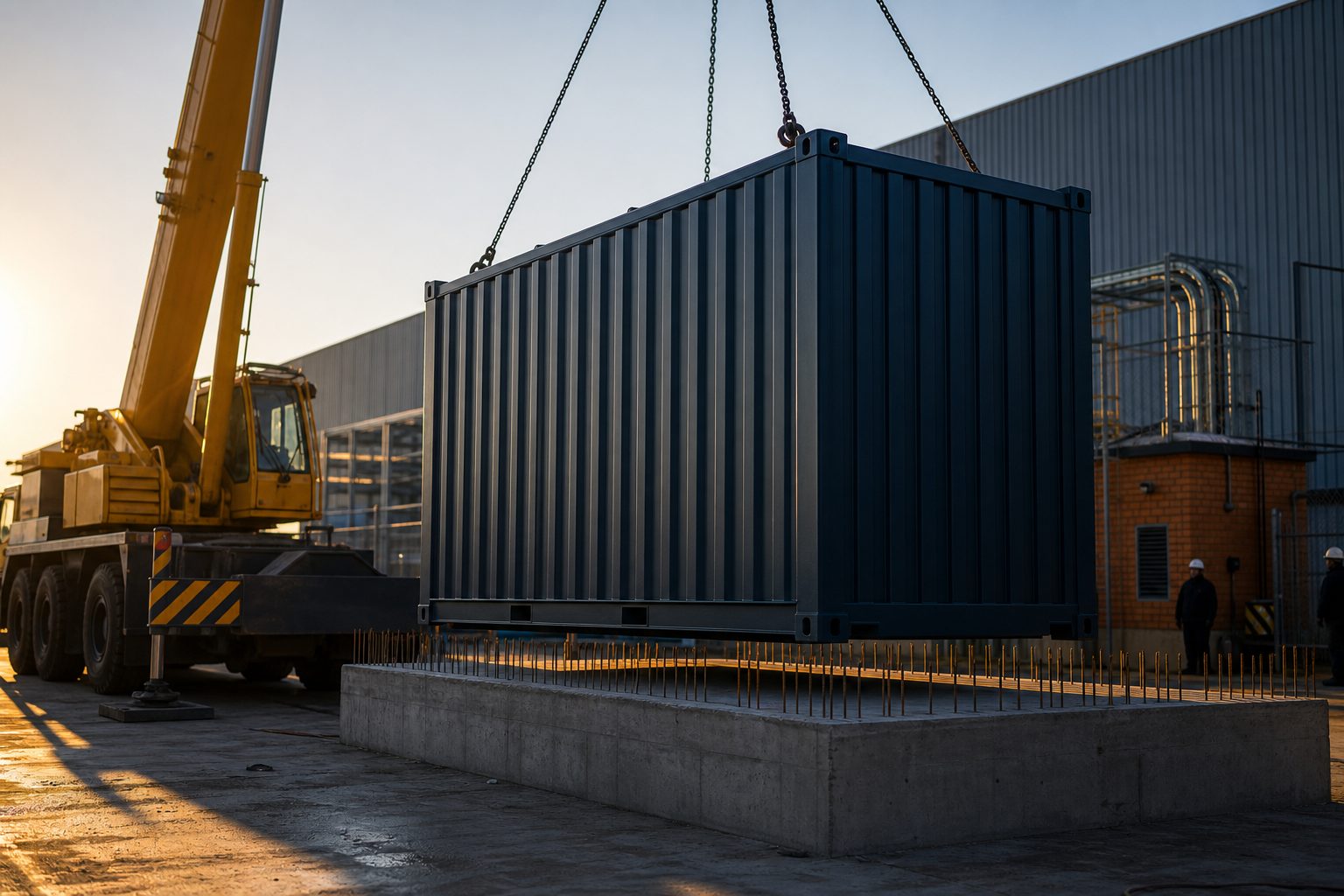
The truck arrives at seven. By ten the crane has set the container on its plinth, the concrete pad it sits on. By dark the AC cables are terminated and the earth is proved.
Day two is commissioning. Day three is protection settings, a witness test, handover.
Seventy-two hours, gate to grid. That part is real. I have watched it happen.
I have also watched a finished battery container sit in a yard in Isando for eleven weeks. It was waiting on one letter.
So there are two honest answers to how long a containerised BESS installation takes. Three days is one, and it matters least. The other runs in months.
You can start that clock this week, for nothing.
Why containerised BESS installation is quick
Most people assume the long pole is the hardware. It is not.
Racking, busbars, hundreds of torque checks, fire detection. In a site-built battery room all of that is yours. In a container it is done and tested at the factory.
So your installer has four jobs left. Seat it, feed it, earth it, prove it.
The crane is a morning’s work. Concrete needs its 28 days. Neither is what leaves projects standing still.
A form is.
What really sets your live date
You cannot connect storage behind your meter until the utility agrees. That agreement is a sequence, and each step needs a document from the step before it.
So start with one question. Who owns your point of supply?
Get this wrong and you lose a month. Eskom-direct customers follow Eskom’s process, on Eskom tariffs: Megaflex, Nightsave Urban, Ruraflex. If Johannesburg, Cape Town or eThekwini bills you, you are a municipal customer. Different tariff, different form, different queue.
Either way, expect most of this list. Each item takes weeks.
- A connection application, with a single-line diagram, datasheets, inverter test papers and grid code evidence.
- A network impact study, priced and booked by the utility. If your feeder or substation is full, this is where you find out. It is the commonest cause of a long slip.
- A written answer on NERSA registration. That turns on the plant’s size, and on whether it can push power back onto the grid.
- Council approval for a structure on your erf. That pulls in the building rules and the fire officer.
- A Certificate of Compliance from a registered person.
None of it is exotic. All of it runs in order. So work side by side. Lodge the form. Book the soil test. Start the civil design in the same week.
The queue is the one part you cannot shorten by working weekends.
The plinth, the point loads and the crane
A loaded container does not spread its weight over the slab. It sits on its corner castings. Four steel corners, four point loads.
So the question is never how thick the slab is. It is what the ground below will carry. Get a soil test. Fill, a high water table or dolomite changes the design completely.
Then check the level, and check again after the pour. A container out of level will not seal its doors. That breaks the weather rating the fire and cooling design both lean on.
Then the lift. The crane talk is not about weight. It is about four things.
- Radius. A crane loses capacity fast as the boom reaches out. Where it can stand decides which machine you need.
- Ground under the outriggers. Those pads put heavy pressure on a small footprint. Watch for soft surfacing, buried services and drain covers.
- Overhead. Lines, gantries, roof overhangs, at the lift point and on the way in. This one gets missed and stops the job dead.
- Access. Gate width, turning circle for a truck and trailer, any weight-limited road.
Book the lift study early. The lift is short. Moving it is not.
Where you put it is three decisions at once
Where the container stands is usually an afterthought. It sets your cable cost, your fire sign-off and your summer output.
Electrical: the AC run is your only long cable
The DC side lives inside the box. So the only long cable run on this job is the AC feed to your point of connection.
Volt drop, cable size and cost climb with distance. Every extra ten metres has a price. So you want the box close.
Fire: space, venting and access
Except you cannot park it against the switchroom wall.
Lithium enclosures need clear space. From your buildings, from your boundary, from whatever you store outside. The way the box vents in a fire matters. So does the approach route for the fire crew.
Those distances come from the box’s own test papers, your fire officer and the building rules.
Notice the fight. Electrical wants it near. Fire wants it far. Settle it on paper first, because moving a plinth is not a small change.
Heat: sun, dust and derating
The cooling on these boxes is built for a heat range. Inland summers push at the top of it. Leave the maker’s clearance around the intakes. Do not corner it where its hot air comes back round.
Then ask for the derating curve. That chart shows how much output the system gives up as it heats up. A unit that backs off on the hottest days fails you exactly when you needed it.
Commissioning stalls on settings, not batteries
The battery works. It was tested before it left the factory. Days two and three go on the join between your plant and the grid.
- Phase rotation and CT polarity. A CT is the sensor that tells the system which way power is flowing. Fit one backwards and the battery discharges into your peak instead of out of it.
- Protection settings. Under and over voltage, under and over frequency, anti-islanding. Set to what your utility asks for, not a factory default from another market.
- The witness test, if they want to attend, plus the sign-off pack.
Each is half a day if the settings were agreed up front. Each is a two-week round trip if not. Ask for them while the form is still in the queue.
Then watch it. An asset nobody watches quietly stops earning. A shift pattern changes. A new chiller arrives. We run ours on EnergyCloud. Whatever you use, insist on seeing real dispatch against real tariff periods.
What a delay actually costs you
Peak shaving works like a dam wall. The battery catches the flood, so your peak never reaches the meter. What the dam is worth depends on the price of water that day.
That price swings hard. On Megaflex a winter peak unit costs 720.19 c/kWh, before VAT. Off-peak it costs 120.03 c/kWh. The gap is 600.16 c, or about R6.00 for every kWh you shift out of peak. In September that gap drops to 178.86 c.
Assumptions (Terawatt modelling, not published figures):
- A 1 MWh-class containerised system on a Megaflex supply, non-local-authority, ≤300 km, ≥500 V and <66 kV. All rates excl VAT.
- 900 kWh delivered into peak periods per weekday, after usable-depth and reserve allowances.
- 90% round-trip efficiency. So you draw 1,000 kWh off-peak to deliver those 900 kWh. The rest is lost as heat.
- 22 billable weekdays a month, no downtime, no allowance for ageing.
- Energy arbitrage only. No demand-charge saving assumed.
Winter weekday: 900 kWh × 720.19 c = R6,481.71 avoided in the peak block. Less 1,000 kWh × 120.03 c = R1,200.30 to charge up off-peak. Net R5,281.41 a weekday, or about R116,191 a month over 22 weekdays.
Summer weekday: 900 kWh × 298.89 c = R2,690.01. Less the same R1,200.30 of charging. Net R1,489.71 a weekday, about R32,774 a month.
Same asset. Same routine. Roughly three and a half times the value in June, July and August.
A project that slips from May to September does not lose a few weeks. It loses a season.
One caution, because proposals overreach here. On Megaflex, peak shaving cuts one demand charge only: the distribution network demand charge, R26.29/kVA/month. It is billed on chargeable demand. That is the biggest gulp of power you took in peak and standard hours.
The network capacity charge of R39.13/kVA/month is billed on annual utilised capacity, a whole year’s figure. It will not drop the month you start shaving.
On Nightsave Urban, where demand charges dominate, the demand saving is the main event instead. Know your tariff first. Still choosing a size? See 1MWh vs 500kWh for industrial peak shaving.
This is not for everyone. Small urban supplies on Businessrate can skip it. Up to 100 kVA, no grid-tied generation, no kVA demand charge, no peak rate to dodge. A battery there is a backup buy, not a bill fix.
What next April does to the sums
Eskom-direct tariffs rose 8.76% on 1 April 2026. Municipalities took 9.01% on the bulk price from 1 July, and eThekwini end users took 9%.
The reason matters more than the number. NERSA got Eskom’s regulatory asset base wrong by R54.7 billion. It is clawing that error back over three years. R12 billion in 2026/27. R23 billion in 2027/28. R19.7 billion after that.
Without the clawback, this year’s rises would have been 5.36% and 6.19%.
Read that again. The instalment you are paying now is the small one. It roughly doubles next year.
So a plant built for next winter meets a higher peak rate than the one here. Bad news for anyone still sitting in a network study. Our tariff and load-shedding outlook looks further out.
Frequently asked questions
Can a 1MWh battery container really be installed in 72 hours?
The mechanical and electrical work genuinely can be. Crane, seat, terminate, energise, commission, hand over. What it leaves out is the utility form, the network study, council approval and the civils.
What takes the longest on a commercial battery project?
Almost always the utility. The connection form sits on the critical path, and so does the network study after it. A full local feeder or substation is where the long delays appear.
What has to be finished before the crane arrives?
Plinth poured, cured and surveyed level. AC cable route and cable ends ready. Earthing in and tested. A lift study confirming crane position, radius and overhead clearance. And the utility’s approval in hand.
Do I need NERSA registration for a battery behind my meter?
It turns on the plant’s size. It also turns on whether it can export power to the grid. So the answer is specific to your setup. Get it in writing from whoever owns your point of supply.
Join the queue now. Install later.
Winter is nearly over, which makes this the right week to start. The form, the network study and the soil test all happen while rates are low. Commissioning then lands before the next high-demand season, not during it.
Allen Sobel, Solar Engineer and CEO, Terawatt Energy.
Source: Eskom Schedule of Standard Prices 2026/27, effective 1 April 2026, non-local-authority, ≤300 km, ≥500 V and <66 kV, excl VAT. Clawback figures from the NERSA 2026/27 decision, reported by Engineering News, 10 March 2026.
